
Condition Monitoring and Asset Management

Condition monitoring is an extremely effective component of your asset management strategy. The performance of your CM program is critical to your reliability strategy, the strategy however is only as good as the execution…Just because you have a “condition monitoring program” does not mean its performing as well as it could be. Unfortunately most condition monitoring programs are not getting the consistent, let alone increasing,  returnse, Condition monitoring is often viewed as a set and forget activity like paying insurance.

The result is that condition monitoring just becomes “another routine maintenance task”. If we are move up the ladder of excellence we have to move condition monitoring from a defect detection activity to a defect elimination strategy.

Condition assessment is about turning data into knowledge, the quality of which will affect the reliability and quality of decision making.  Predicting the future requires requires good “knowledge” and not just good data. A key challenge for organisations is to ensure that such knowledge gleaned across many assets, are secured, and made more widely available for future decision making to counteract the potential loss of knowledge when staff leave an organisation or when control of an asset passes from one organisation to another. Concepts like Felix help prevent loss of knowledge (and information) at key stages in the Life Cycle of an asset.
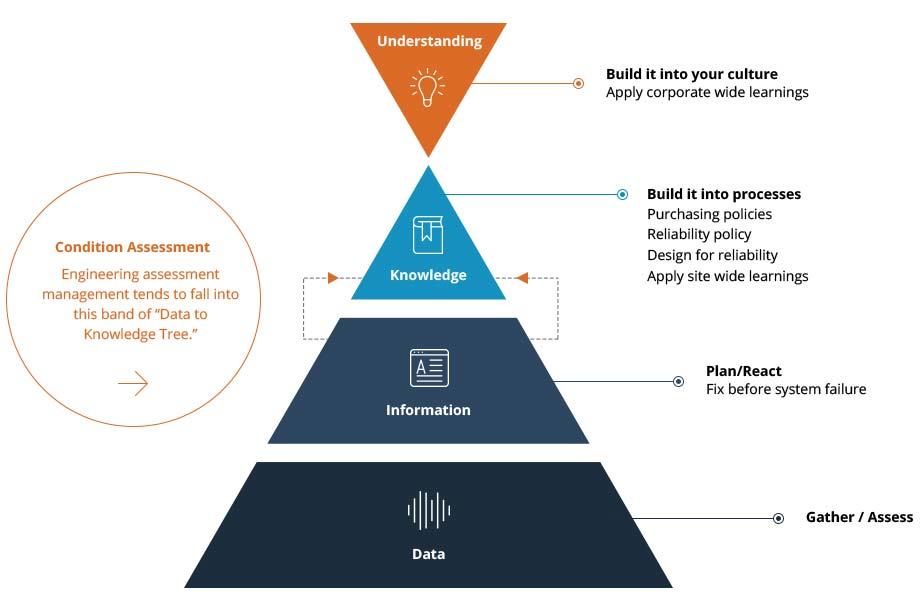
Most progressive owners of physical assets employ some form of condition monitoring as a strategy to drive maintenance and replacement.decisions.  As such the quality of condition assessments has a direct outcome on effectiveness  and prioritisation of maintenance spend.  The is no shortage of condition assessment technologies and systems designed to automate, or take away the decision making, but often these systems operate in a silo with mixed results- often of more value as a protective system.  A problem with the “protective systems” approach to machine health monitoring is that such systems are often poor at fault prognosis, and don’t draw from cross technology assessment indicators (let alone fuzzy logic decision inputs) in raising and prioritising alarms and hence can become relied upon by a lazy condition monitoring program, which should otherwise be aiming to cast an eye over all all asset health indicators known to the condition monitoring effort with a view to supporting a defect elimination program in line with the performance requirements of the assets under care.

At all times a Condition Monitoring program should be aiming to:

  • Reduce risk;
  • Optimise condition assessment outcomes 
  • Enhanced asset knowledge across asset classes
  • Improve prioritisation of investment in asset renewals
  • Improve procurement decisions 
  • Optimise asset performance outcomes  and
  • Enhance alignment with appropriate industry standards E.g. ISO55000. 
keyboard_arrow_up